
Frontend Architecture
Next.js 16 (App Router) · React 19 · Tailwind CSS 4 · shadcn/ui · framer-motion · recharts. Source in web/. All backend calls go through the typed client web/src/lib/api.ts.
Next.js 16 has breaking changes vs older docs — read
node_modules/next/dist/docs/before editing framework code.
Screenshots
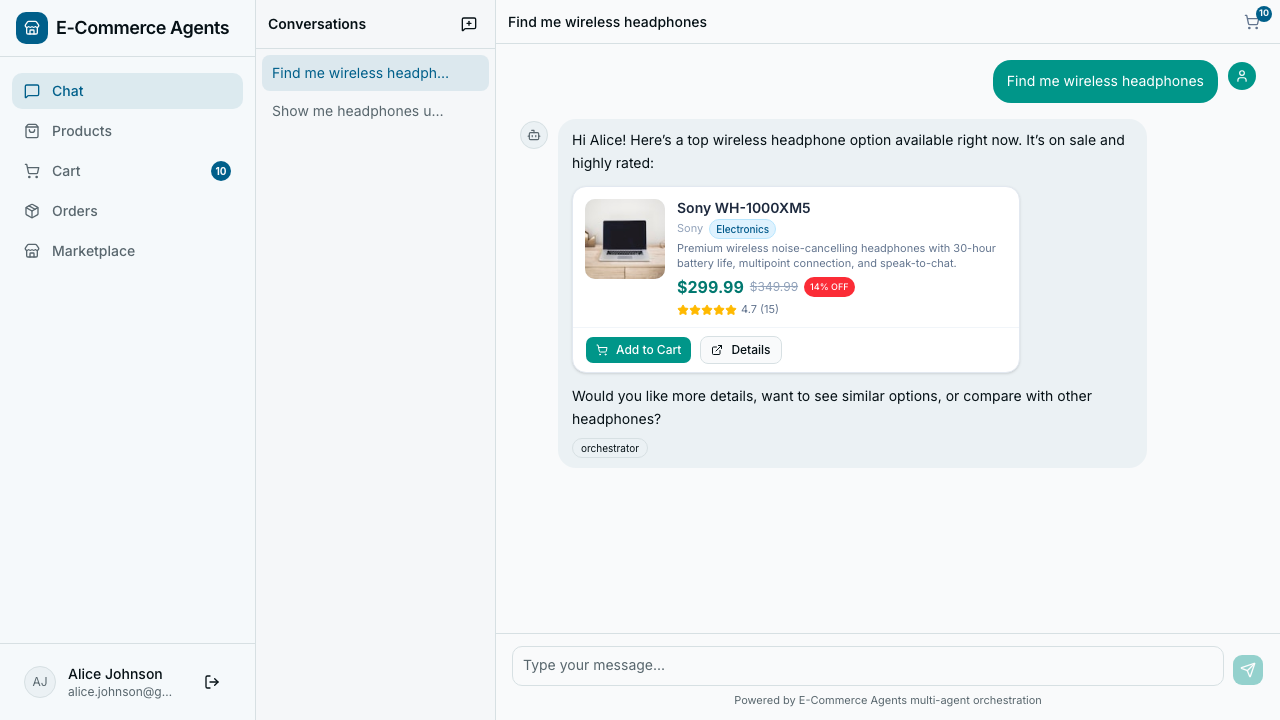 | 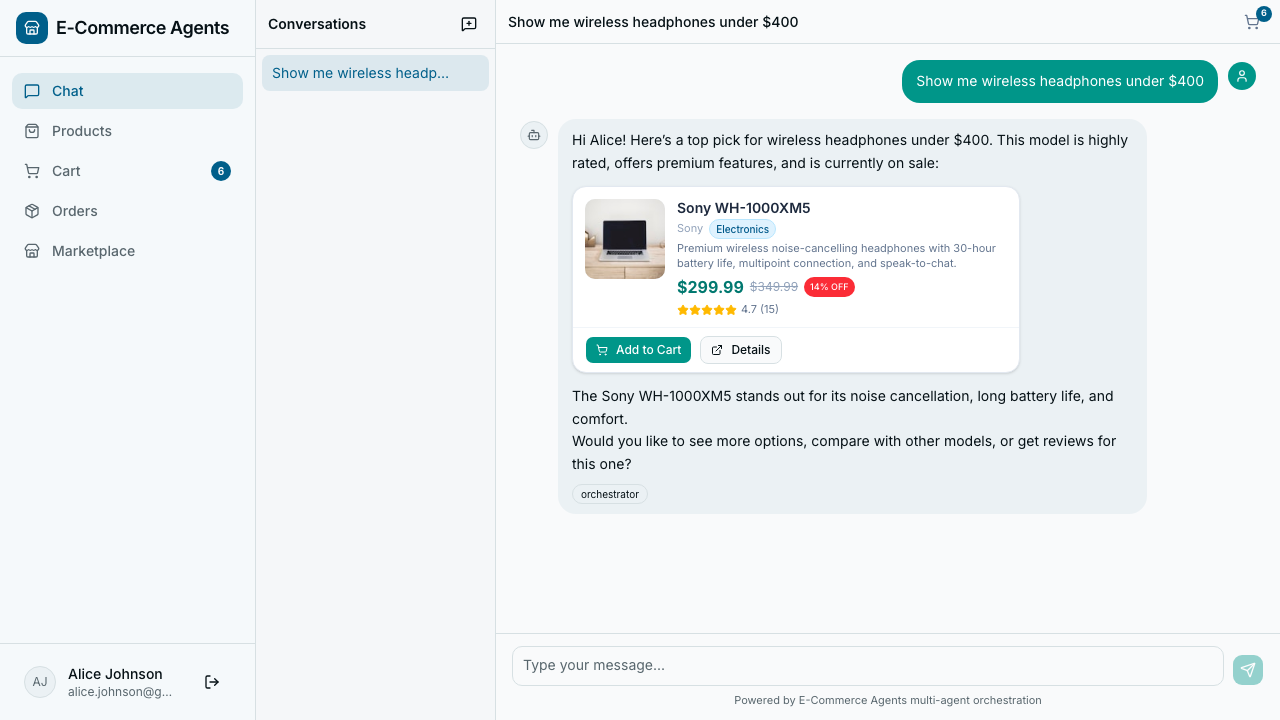 |
| AI shopping assistant — product cards from Product Discovery agent | Agent activity timeline — live orchestrator → specialist → tool trace |
Audiences & routing
Two front doors, by audience:
| Area | Routes | Auth | Notes |
|---|---|---|---|
| Project landing | / | public | OSS showcase page (architecture, agents, stack). CTA “Try the demo” → /shop. |
| Public storefront | /shop, /shop/products, /shop/products/[id], /shop/assistant | public | Browse, search, and discovery chat with no login. |
| Account console | (app)/ → /home, /chat, /orders, /orders/[id], /checkout, /profile, /admin/*, /seller/* | required | Sidebar shell; (app)/layout.tsx redirects anonymous users to /login. |
| Auth | /login, /signup | public | Self-contained JWT. |
The storefront is public because the backend serves product browse + chat anonymously (optional_auth on /api/products and /api/chat*). Account actions (cart checkout, orders, tracking, returns) require sign-in.
Design system & theming
- OKLCH tokens in
web/src/app/globals.css(--background,--foreground,--card,--primary,--muted,--chart-1..5, sidebar tokens). Use tokens, not hardcoded slate/white — that breaks dark mode. - Dark mode = a
.darkclass on<html>.ThemeToggle(components/ui/theme-toggle.tsx) flips it viauseSyncExternalStore; a no-flash init script in the root layout applies the persisted/system theme before paint. - Motion variants in
web/src/lib/motion.ts(reduced-motion aware). - Primitives:
StatCard,SectionHeader,Skeleton,ChartContainer(recharts wrapper), command palette (Cmd-K).
Chat / SSE streaming + agent timeline
api.chatStream(message, conversationId, onChunk, signal?, { onStep }) consumes the orchestrator SSE stream POST /api/chat/stream. Frame types:
data: <text>— streamed answer tokens (onChunk).event: step+data: {AgentStep}— one tool-call step ({agent, tool_name, tool_input, tool_output, status, duration_ms}) →onStep.event: metadata+data: {conversation_id, agents_involved}— final.data: [DONE]— terminator.
AgentTimeline (components/chat/agent-timeline.tsx) renders the steps as a collapsible “Agent activity” disclosure (orchestrator → specialist → tool). Rich assistant content (product/order/checkout cards) is parsed by components/chat/rich-message.tsx.
SSE streaming sequence
sequenceDiagram
    accTitle: SSE streaming sequence
    participant UI as Chat UI
    participant API as api.ts chatStream()
    participant ORCH as Orchestrator SSE<br/>POST /api/chat/stream
    participant SPEC as Specialist Agent

    UI->>API: chatStream(message, convId, onChunk, {onStep})
    API->>ORCH: POST /api/chat/stream (JWT Bearer)
    Note over ORCH: Opens SSE response<br/>Content-Type: text/event-stream

    ORCH->>SPEC: A2A /message:send
    SPEC-->>ORCH: Tool result (e.g. product list)

    ORCH-->>API: event: step\ndata: {agent, tool_name, ...}
    API->>UI: onStep(AgentStep) → AgentTimeline renders step

    ORCH-->>API: data: token token token ...
    API->>UI: onChunk(token) → streamed text appears

    ORCH-->>API: event: metadata\ndata: {conversation_id, agents_involved}
    ORCH-->>API: data: [DONE]
    API->>UI: Stream closed
Testing
- Unit/component: vitest + React Testing Library (
pnpm test, jsdom). - E2E: Playwright under
web/e2e/.ui-smoke.spec.tsruns backend-free (mocked auth via localStorage +page.route('**/api/**')); the other specs need the full live stack. Playwright is intentionally not run in CI.
Related
docs/architecture.md— full system architecture and SSE orchestration patterndocs/api-reference.md— REST endpoints the frontend callsdocs/troubleshooting.md— frontend-specific issues (products not showing, CORS)- Project README
Source: docs/frontend.md — this page is generated from the repository.