
Architecture
How the containers fit together, and what talks to what.
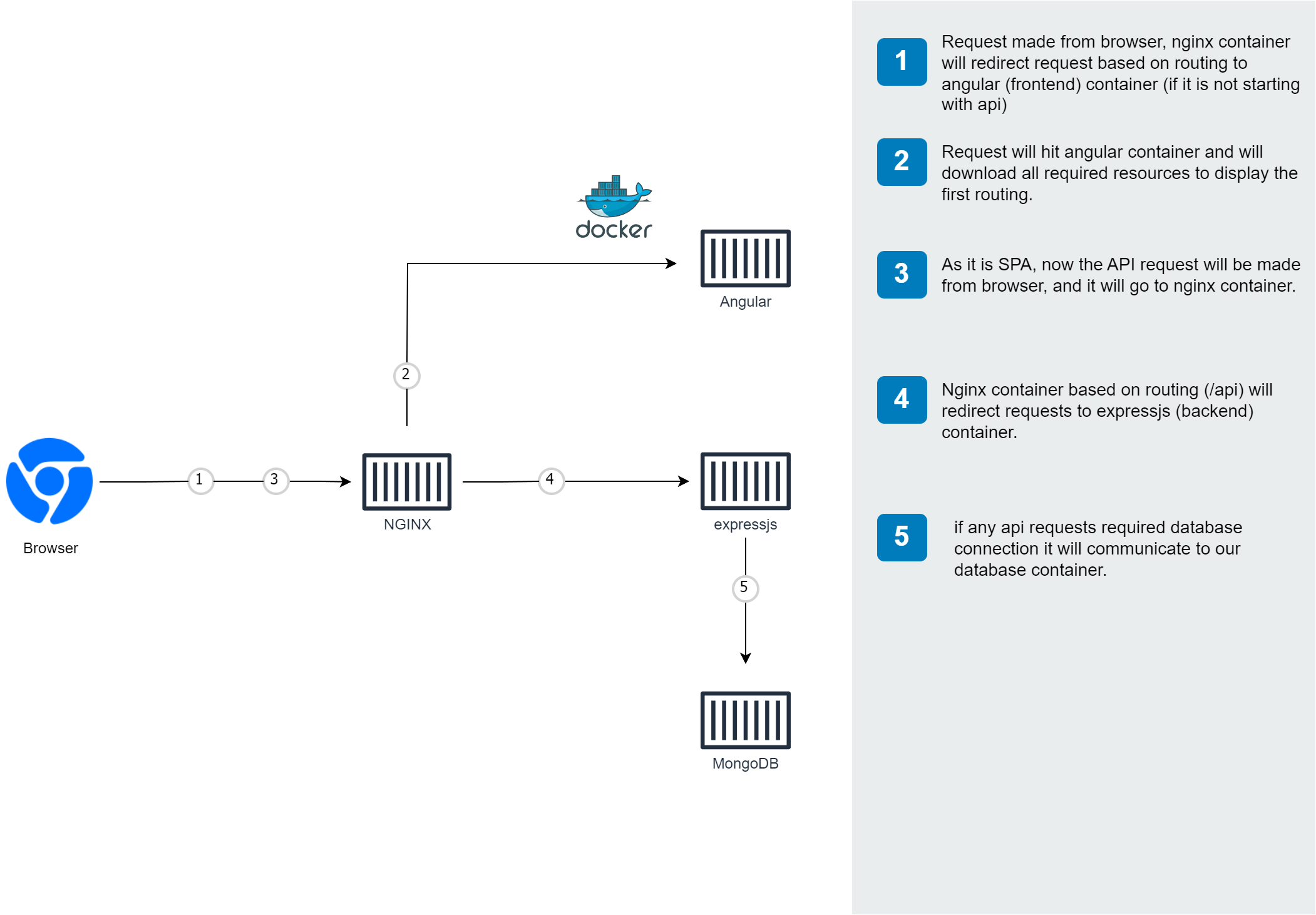
Components
| Container | Image | Responsibility |
|---|---|---|
nginx | built from loadbalancer/ | The gateway. The only container published to the host in production mode |
angular | built from frontend/ | Nginx serving the compiled Angular bundle. Not a Node server — there is no SSR |
express | built from api/ | The REST API. Node 24, Express 5, TypeScript |
database | mongo:8.2 | MongoDB, reachable only from express in production mode |
Deployment Modes
There are three, and they differ only in what is built and what is published:
| Mode | File | Containers | Published to the host |
|---|---|---|---|
| Development | docker-compose.yml | 3 (no gateway) | :4000 frontend, :3000 API, :27017 MongoDB |
| Production-shaped | docker-compose.nginx.yml | 4 | http://localhost only |
| Prebuilt images | docker-compose.hub.yml | 4 | http://localhost only |
Development mode publishes each service so you can call the API directly with curl or point a MongoDB client at the database. The other two put everything behind the gateway, which is what makes the “single entry point” property real rather than aspirational.
Request Flow
In the Nginx modes, everything arrives on port 80:
- The browser requests
http://localhost/. Nginx proxies it to theangularcontainer, which returns the SPA shell and its assets. - The SPA runs in the browser and calls the API at
/api/...— the same origin, so no CORS is involved. - Nginx matches the
/apiprefix and proxies toexpress:3000. - Express queries MongoDB over the internal network and returns JSON.
Nginx resolves both upstreams through Docker’s DNS on each request rather than once at startup, so recreating a backend container does not leave the gateway pointing at an address that no longer exists.
Two Nginx Configs
They are different files and are easy to confuse:
| File | Listens on | Role |
|---|---|---|
loadbalancer/nginx.conf | 8080 | The gateway: routes /api to Express, everything else to the frontend |
frontend/nginx.conf | 4000 | Inside the Angular image: serves static files with an SPA fallback to index.html |
Both containers run as an unprivileged user, which is why the gateway listens on 8080 rather than 80 — binding a port below 1024 as a non-root user needs an extra capability. Compose publishes 80:8080, so nothing changes for the user.
Startup Order
Containers do not start in an arbitrary order. Each service declares a healthcheck, and depends_on waits on it:
database (mongosh ping) -> express (GET /health) -> angular (GET /) -> nginx
Express also waits for its own MongoDB connection before it begins listening, so a container reporting healthy is one that can actually serve a request.